Girly Coloring Book Mockup – More Than a Pretty Preview
If you’ve ever tried to sell a coloring book online, you know the hardest part isn’t the drawing—it’s making people stop scrolling long enough to click. That’s where a Girly Coloring Book Mockup comes in. It’s not just a file you drop your artwork into; it’s a quiet sales partner that shows potential buyers exactly what they’ll get. Whether you’re an illustrator, a small print shop owner, or someone testing the waters of print-on-demand, this tool can save you hours of staging photos and give your work a polish that feels almost too easy.
For Illustrators and Artists: Presenting Your Vision Without the Setup
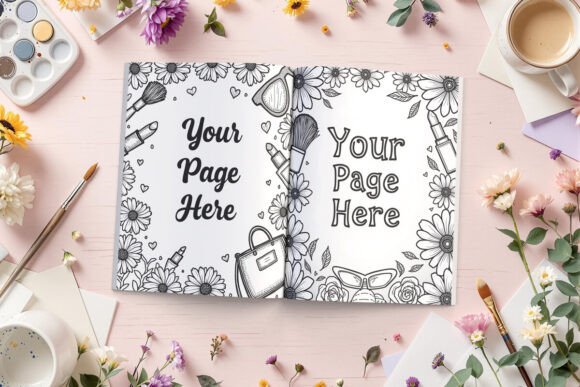
Imagine you’ve just finished a series of floral princess designs, delicate mandalas, or whimsical animal scenes. You know the linework is clean, the pages are meant to be inviting. But when you try to photograph the printed book at home, the lighting feels off, the shadows are harsh, and your cat decides to photobomb. A Girly Coloring Book Mockup lets you skip all that. You upload your cover and a sample interior page, and suddenly your book is resting on a pastel desk next to a cup of tea, or lying open on a cozy rug.
I’ve seen fellow artists use these mockups to create portfolio pieces that look like they’ve been professionally shot. One friend sent a mockup to a publisher and got a faster reply than when she’d sent flat scans. The reason is simple: a mockup gives context. It helps people imagine the product in their hands, especially when that product is meant for relaxation and creativity. For girly, floral, or fantasy themes, the right mockup reinforces the mood—soft, pretty, and personal.
Self-Publishers on Amazon KDP and Etsy: Turning Previews into Sales
If you’ve listed on Amazon KDP or Etsy, you know that your main image is everything. A flat PNG of a coloring book cover might look okay in search results, but it blends in. Customers scrolling past want to see what the inside might feel like. With a Girly Coloring Book Mockup, you can show the cover resting naturally, maybe with a marker or colored pencil beside it. That small visual cue signals “this is a real book you can actually color in.”
I’ve tried both staged photography and mockups for my own KDP listings, and the mockup consistently got a higher click-through rate. Why? Because photos of an actual printed book often have wrinkles, finger smudges, or glare. A good mockup gives you a clean, aspirational image that still feels authentic. For a girly-themed book—think unicorns, butterflies, or vintage dresses—a mockup with pink tones or soft textures can attract the right audience even before they read the description.
- Etsy sellers can also use mockups in listing photos and social media posts. One seller I know creates seasonal mockups with the same coloring book but different backgrounds (Easter eggs, autumn leaves) to keep her shop feeling fresh all year.
- Pay attention to the mockup’s resolution. Amazon requires at least 1000 pixels on the longest side. Most premium mockups offer 300 dpi or higher, so you can zoom in without losing clarity.
- Test multiple mockup angles. Some buyers want to see the front cover only; others respond better to an open book showing a sample page. A set of two or three mockups can cover both preferences.
Small Businesses and Print Shops: Client Proofs That Delight
Running a small print shop or offering custom coloring book services means you often deal with clients who aren’t visual designers. They might describe what they want—“something girly, maybe with roses and fairies”—but struggle to picture the final product. Instead of printing a full proof that costs time and paper, you can use a Girly Coloring Book Mockup to show them how their art or photos will look on the cover and inside pages.
I’ve watched a print-on-demand boutique do exactly this: they ask clients to send their line art or logo, then slap it onto a mockup of a coloring book with a pastel finish. The client gets an instant idea of the scale, layout, and overall vibe. Changes are easy to make before anything goes to press. This approach also works for party favors, wedding coloring books, or kids’ event activity books that lean toward a feminine style. The mockup becomes a communication tool, not just a preview.
A strength of using mockups in this scenario is the professional edge it gives you. Instead of saying “It’ll look nice,” you can show “This is what it will look nice like.” The limitation, of course, is that a mockup can’t replicate the exact paper texture or binding weight. But for initial approvals, it’s more than enough.
Digital Content Creators: Selling Printables and Stock Art
Maybe you don’t sell physical books at all. You might offer printable coloring pages on Creative Market, Etsy digital downloads, or even a subscription for girly-themed pages. A Girly Coloring Book Mockup is still incredibly useful here. Customers want to see what a finished page could look like when printed, or how the cover would appear as a product thumbnail. By placing your PDF cover or a sample spread inside a mockup, you give your digital file a sense of tangibility.
For example, a creator I follow makes monthly coloring kits that include floral borders and script quotes. She uses the same basic mockup for each kit but swaps the background layer to match the season. Her buyers say the mockup helps them feel confident about the print quality, even though they’re downloading a file. If you’re selling on platforms that allow previews, a mockup can be the difference between a casual view and a purchase.
When a Mockup Might Not Fit
Of course, no tool is perfect. Girly Coloring Book Mockups usually come with fixed lighting and angles. If your cover design has very unusual proportions or a non-standard trim size, you may struggle to find a mockup that matches. Also, some mockups include props (flowers, pencils, frames) that look great but can distract from your actual cover. Always check whether the mockup’s styling aligns with your brand. A mockup that feels too “cute” might clash with a bolder, darker girly aesthetic like gothic fairy art. In that case, you’re better off with a neutral mockup and adding your own props digitally.
Marketers and Promoters: Testing Covers Without Printing
Before you commit to a full print run, you might want to see how your cover performs in the wild. A Girly Coloring Book Mockup makes A/B testing easy. Create two different covers—maybe one with a pastel pink background and one with lavender—and drop each into the same mockup. Then use them in social media ads, Pinterest pins, or email newsletters to see which gets more clicks.
I’ve done exactly this for a friend’s coloring book launch. We tested three cover variants using the same mockup set. The one with a more whimsical illustration style (soft outlines, a central fairy) outperformed the one with a busier pattern. Without mockups, we would have had to order three physical proofs, wait for shipping, and then photograph each one—taking over a week. With mockups, the test took an afternoon. This application is especially valuable if you’re targeting adults 20–50 who grew up with coloring as a nostalgia hobby; a cover that evokes a specific childhood memory (think Lisa Frank-inspired or vintage storybook) can be tested rapidly.
Considerations Before Choosing Your Mockup
Not all Girly Coloring Book Mockups are created equal. Here are a few things to watch for:
- File format and layers. Most good mockups are PSD files with smart objects. If you’re not comfortable with Photoshop, look for templates that support other editing tools or come with video tutorials.
- License terms. Some mockups are for personal use only; others allow commercial use. If you’re selling the resulting images on Amazon or your own store, make sure the license covers that.
- Customizability. Can you change the interior pages? What about shadows, background color, or props? A mockup that lets you tweak these gives you more control to match your brand’s voice.
- Realism vs. stylization. Highly realistic mockups can look like photographs. Stylized mockups (flat vector style, watercolor textures) work best if your brand is more illustrative. For a girly coloring book, I personally prefer a middle ground: realistic enough to feel credible, but with a soft, inviting aesthetic that echoes the coloring experience.
On the limitation side, keep in mind that a mockup can’t show you how the paper bleeds when colored with markers, or whether the binding lies flat. It’s a marketing aid, not a production test. Always order a physical proof before your final print run. But for everything else—previews, ads, client proofs, portfolio building—a well-chosen Girly Coloring Book Mockup will feel like a cheat code for fast, beautiful visuals.
Whether you’re an artist dreaming of your first published book, a small business owner creating custom gifts, or a digital seller building a library of printables, the right mockup does more than present your work. It wraps your creativity in a context that speaks directly to the person who would love to pick up a coloring book and unwind. And that’s the whole point.