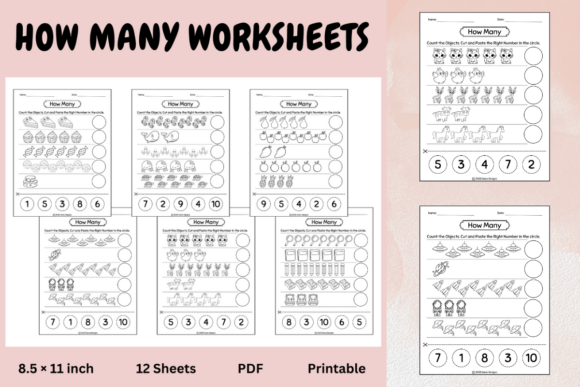
How Many Worksheets 1 – 10: Building Numeracy Foundations in an Evolving Educational Landscape
In a world increasingly shaped by data, algorithms, and quantitative thinking, the ability to grasp basic numerical concepts early in life has never been more consequential. While much attention in education circles focuses on advanced STEM skills, digital literacy, and coding for children, the quiet, unglamorous work of learning to count from one to ten remains the bedrock upon which all later mathematical understanding is built. This is where How Many Worksheets 1 – 10 enters the picture — not as a simple throwback to childhood busywork, but as a carefully designed tool for developing number sense, one-to-one correspondence, and early confidence in mathematics.
For educators, parents, homeschoolers, and content creators alike, understanding the purpose, evolution, and effective use of these worksheets is essential. They are not merely exercises in filling in blanks; they are structured opportunities for children to internalize what numbers represent, how quantities relate to symbols, and how the world around them can be counted, compared, and understood. This article explores what How Many Worksheets 1 – 10 really offers, why it has gained renewed attention among modern educators and creators, and how it fits into broader trends in early childhood learning, digital content creation, and practical teaching strategies.
What Are How Many Worksheets 1 – 10 and Why Do They Matter?
At their core, How Many Worksheets 1 – 10 are learning resources designed to help young children — typically ages three to six — practice counting objects and identifying the corresponding numeral. A standard worksheet might display a group of apples, stars, or animals and ask the child to count them and then circle, write, or match the correct number from one to ten. The format is simple, but the cognitive work is substantial. Children must coordinate visual attention, counting aloud or silently, and symbol recognition in a single activity.
What makes these worksheets particularly relevant today is the growing recognition that early numeracy is a strong predictor of later academic success — not just in math, but across subjects. Research in developmental psychology and education consistently shows that children who develop solid number sense before first grade tend to perform better in reading, problem-solving, and executive function tasks. How Many Worksheets 1 – 10 directly supports this foundational skill by offering repeated, structured practice in a low-pressure format. For parents looking to supplement school learning, for teachers seeking quick formative assessments, and for content creators designing math resources, these worksheets represent a versatile and evidence-aligned tool.
Moreover, the topic has gained relevance as more families and educators embrace personalized learning. In a crowded marketplace of apps, games, and digital curricula, a well-designed worksheet offers something screen-based activities often lack: focused, distraction-free practice that builds concentration and fine motor skills alongside number knowledge. The physical act of circling, writing, or coloring reinforces learning in ways that tapping a screen sometimes cannot replicate.
How Early Numeracy Worksheets Have Evolved and Why People Are Paying More Attention
The concept of counting worksheets is far from new, but the way educators and creators approach How Many Worksheets 1 – 10 has shifted significantly over the past decade. Traditional worksheets were often monotonous, featuring rows of identical objects and little variation. Today, the best examples incorporate diverse visual themes — animals, nature, everyday objects, seasonal imagery — and are designed with attention to developmental appropriateness, clarity, and engagement. This evolution reflects a broader understanding that early math learning should be playful, meaningful, and connected to real-world experiences.
Several trends have fueled this renewed interest. First, the global emphasis on early childhood education has intensified, with governments, nonprofits, and educational institutions investing more heavily in pre-K and kindergarten resources. Parents are more aware than ever of the importance of the early years, and many seek high-quality, affordable materials they can use at home. How Many Worksheets 1 – 10 fits perfectly into this demand, offering a low-cost, high-impact activity that requires no technology, internet connection, or special equipment.
Second, the rise of homeschooling and hybrid learning models — accelerated by the pandemic but sustained by changing family preferences — has created a need for structured, downloadable resources. Parents who are not trained teachers often feel uncertain about how to teach math concepts. Clear, well-organized worksheets provide a reassuring framework: here is what to do, here is how many, and here is the answer. This simplicity empowers caregivers to support learning without requiring expertise.
Third, the content creation economy has opened new opportunities for educators, designers, and entrepreneurs. Platforms like Teachers Pay Teachers, Etsy, and Gumroad have made it possible for individuals to create and sell original How Many Worksheets 1 – 10 sets to a global audience. This has led to an explosion of creativity and variety, with worksheets now available in countless themes, languages, difficulty levels, and aesthetic styles. For creators, this niche offers steady demand, relatively low production complexity, and the chance to build a loyal customer base among teachers and parents.
Finally, the growing conversation around screen time and developmental health has made physical worksheets more appealing to many families. In an era when children are exposed to smartphones and tablets from an early age, parents are actively seeking offline learning activities. How Many Worksheets 1 – 10 provides a tactile, analog experience that supports focus, handwriting practice, and visual attention without the blue light and notifications associated with digital devices.
Practical Implications for Educators, Parents, and Content Creators
Whether you are a teacher planning lessons, a parent supporting your child at home, or a creator developing resources for others, understanding how to use How Many Worksheets 1 – 10 effectively can make a meaningful difference. Here is how the topic translates into practical, everyday action for each audience.
For Educators
Teachers in preschool, kindergarten, and first grade can integrate these worksheets into their math centers, morning work, or small-group instruction. The key is to use them not as busy work but as intentional practice. Pair a worksheet with a hands-on counting activity — such as counting blocks, buttons, or snacks — to reinforce the concept in multiple modes. Many educators also use How Many Worksheets 1 – 10 as a quick assessment tool: by observing which numbers a child consistently miscounts or confuses, a teacher can identify gaps and tailor instruction accordingly.
Practical recommendation: Build a small library of themed worksheets — one for apples, one for ocean creatures, one for vehicles — and rotate them throughout the year to maintain interest while reinforcing the same core skill. Keep copies on hand for early finishers or for children who need extra practice without feeling singled out.
For Parents and Homeschoolers
For families, these worksheets offer a structured way to engage with early math without requiring lesson planning expertise. A simple routine — one worksheet per day, combined with counting real objects around the house — can yield steady progress. The beauty of How Many Worksheets 1 – 10 is that it meets children where they are: a child who is just beginning to count may need to point to each object slowly, while a more advanced child can race through the sheet and then count backwards or compare quantities.
Practical recommendation: Turn worksheet time into a conversation. Ask questions like “How did you know there were seven?” or “What if I added one more?” This kind of dialogue builds mathematical thinking far beyond the worksheet itself. Also, consider laminating worksheets or placing them in reusable dry-erase sleeves to allow multiple uses with different children or repeated practice.
For Content Creators and Entrepreneurs
If you create educational resources — whether as a teacher selling on a marketplace, a designer building a brand, or a blogger sharing free printables — How Many Worksheets 1 – 10 is a category with consistent demand and room for originality. The market is not oversaturated; it is differentiated by theme, quality, and pedagogical thoughtfulness. Creators who succeed in this space pay attention to clear layout, age-appropriate imagery, and inclusive representation (e.g., diverse skin tones in characters, varied family structures).
Practical recommendation: Consider bundling a set of ten worksheets with a progress tracker, a certificate of achievement, or a simple matching game. This adds perceived value and helps buyers feel they are getting a complete learning experience. Also, include a brief parent or teacher guide explaining how to use the worksheets effectively — this builds trust and demonstrates expertise, which aligns with E-E-A-T principles.
Realistic Examples and Observations
To ground this discussion in real-world practice, consider a typical preschool classroom. The teacher places a How Many Worksheet 1 – 10 featuring ladybugs on a table next to a small jar of counters. A child approaches, looks at the sheet, and begins counting: one, two, three, four, five ladybugs. She writes the numeral 5 in the box. Then she checks by touching each ladybug with her finger and counting again. This self-checking behavior — catching her own mistakes — is a skill that develops precisely because of the worksheet’s repetitive, structured nature. Over weeks, the child moves from counting slowly and sometimes incorrectly to automatic, confident recognition of quantities up to ten.
Another example comes from a homeschool setting. A mother of a four-year-old and a six-year-old uses the same worksheet set but adapts it: the younger child counts and circles the correct number, while the older child writes the numeral and also writes the number word. This simple differentiation shows how a single resource can serve multiple developmental levels, saving time and money while meeting each child’s needs.
For content creators, a popular pattern is to release seasonal or themed packs. A creator might offer a free sample of How Many Worksheets 1 – 10 with a back-to-school theme, then sell the full bundle with ten additional themes for a low price. This strategy builds an email list, generates reviews, and establishes credibility. Many successful creators note that early math resources are among their best-performing products because the demand is steady and the audience is consistently searching for help with counting.
How to Choose and Use How Many Worksheets 1 – 10 Effectively
Not all worksheets are created equal. To get the most out of this resource, consider the following criteria when selecting or designing materials.
- Clarity of visual design. Objects should be distinct, evenly spaced, and easy to count without visual clutter. Avoid overly complex illustrations that confuse rather than clarify.
- Progressive difficulty. The best worksheet sets start with smaller numbers (1–3) and gradually build to 10, allowing children to experience success early and develop confidence.
- Variety of representation. Some sheets should use objects arranged in a line, others in a scattered pattern, and still others in a ten-frame. This helps children learn to count in different configurations, a key skill for later math.
- Clear instructions. Even if the child cannot read yet, the worksheet should be intuitive. Symbols, arrows, or simple icons can guide the task without relying on text.
- Durable or reusable formats. For repeated use, consider laminating or using dry-erase pockets. This is especially practical for classrooms and families with multiple children.
When using the worksheets, avoid overdoing it. Two to three sessions per week, each lasting about ten to fifteen minutes, is often sufficient for steady progress without causing fatigue or frustration. The goal is not to complete every worksheet in a set, but to build understanding at a pace that feels natural for the child.
Looking Ahead: The Place of Analog Resources in a Digital World
As technology continues to reshape education, it is easy to assume that physical worksheets will become obsolete. Yet the evidence suggests otherwise. Educators and parents consistently report that young children benefit from a mix of digital and analog activities. How Many Worksheets 1 – 10 occupies a unique and durable niche: it is simple, affordable, accessible, and effective. It requires no login, no battery, no internet connection, and no screen time debate. For families seeking balance, for teachers managing diverse classrooms, and for creators building sustainable businesses, this is an asset that will remain relevant for years to come.
The broader trend toward intentional, low-tech learning experiences — especially in early childhood — supports the continued use of worksheets as part of a varied diet of learning activities. When used thoughtfully, they are not a relic of the past but a wise and practical tool for building the foundational skills that every child needs.
Final thought: The question “How many?” is one of the first mathematical questions a child learns to answer. How Many Worksheets 1 – 10 turns that question into a structured, repeatable, and rewarding practice. For anyone involved in educating or creating for young children, understanding how to use and develop these resources well is a small investment that pays lasting dividends in numeracy, confidence, and curiosity.